FERN PLANTS GALLERY PAGES Fern Culture with British Ferns and their Allies comprising the Ferns, Club-mosses, Pepperworts and Horsetails by Thomas Moore, F.L.S, F.H.S., Etc. London George Routledge and Sons, Broadway, Ludgate Hill. Hardcover published in 1861 provides details on British Ferns |
TYPE OF FERN TO GROW
Where to see UNITED STATES WALES |
USE OF FERN
Where to see AUSTRALIA CANADA ENGLAND FRANCE GERMANY IRELAND NETHERLANDS
|
SPORE COLOUR BED PICTURES Where to see NEW ZEALAND SCOTLAND UNITED STATES |
A Natural History of Britain's Ferns by Christopher N. Page. Published by William Collins Sons & Co. Ltd in 1988. ISBN 0 00 219382 5 (limpback edition) provides details of Coastal, Man-made Landscapes, Woodland, Wetland, Grassland and Rock Outcrops, Heath and Moorland, Lower Mountain Habitats, Upper Mountain Habitats and Atlantic Fringe Ferns. Tree Ferns by Mark F. Large & John E. Braggins. Published by Timber Press in 2004. ISBN 978-1-60469-176-4 is a scientifically accurate book dealing with Tree Fern species cultivated in the United States and the Pacific, but little known and rare tree ferns are also included. The Observer's Book of Ferns, revised by Francis Rose, previous editions compiled by W.J.Stokoe. Published by Frederick Warne & Co. Ltd in 1965 provides a comprehensive guide to 45 British species of Ferns. It provides details of habitat and how to use those ferns. The Plant Lover's Guide to Ferns by Richard Steffen & Sue Olsen. Published in 2015 by Timber Press, Inc. ISBN 978-1-60469- Success with Indoor Ferns, edited by Lesley Young. Reprinted 1998. ISBN 1 85391 554 8. It details the care of indoor ferns with their position, choice and fern care. |
Where to see UNITED STATES |
|
|
|||
|
||||||||||
Fern |
Foliage Colour and |
Height x Spread in inches (cms) |
Type of Fern to Grow |
Use of Fern |
Comments |
Frond |
Credit |
Form |
||
Pteris buchananii |
|
|
|
|
|
|
|
|
||
Pteris 'Childsii' |
|
|
|
|
|
|
|
|
||
Pteris comans |
|
|
|
|
|
|
|
|
||
Pteris cretica Tropics and Subtropics The species as a whole occurs widely throughout the tropics and subtropics. It is frequently cultivated and escapes, obscuring the natural distribution. 大叶井口边草 |
Rhizome creeping or ascending, ca. 1 cm in diam., apex with black-brown scales. Fronds clustered, dimorphic or subdimorphic. |
|
The Brakes (Pteris) Propagation: By spores sown on fine sandy peat in well-drained pans in temperature 80F (27C) at any time; dwarf species by division of plants, October or April. |
Suitable for House Fern.
Large genus of mostly tropical ferns. The hardy species formerly included here will be found under Pteridium. |
Fronds to 12 inches (30 cms) long. 400-3200 m. |
|
Plant Delights Nursery sells Pteris cretica 'Ping Wu'. This fascinating Hans Hansen selection of Pteris cretica (coll #HH03CH099) comes from 3,500' elevation near Ping Wu in China's Sichuan Province. In the wild, this dwarf 15" tall x 30" wide plant was found growing among normal 2'+ tall individuals. Even when grown from spores, Pteris cretica 'Ping Wu' has retained the rock garden-size, dense, dwarf habit and extraordinarily narrow fronds. Five-fingered leaves adorn the 1' wide, deer-resistant, evergreen clump on this easy-to-grow fern. This fern looks so good all year it has become one of my all-time favorites, although I'm not thoroughly convinced that it doesn't belong to a different Pteris species. |
|
||
Pteris cretica cultivars |
|
|
The Brakes (Pteris) Propagation: By spores sown on fine sandy peat in well-drained pans in temperature 80F (27C) at any time; dwarf species by division of plants, October or April. |
Suitable for House Fern.
Large genus of mostly tropical ferns. The hardy species formerly included here will be found under Pteridium. |
|
|
|
|
||
Pteris dentata |
|
|
|
|
|
|
|
|
||
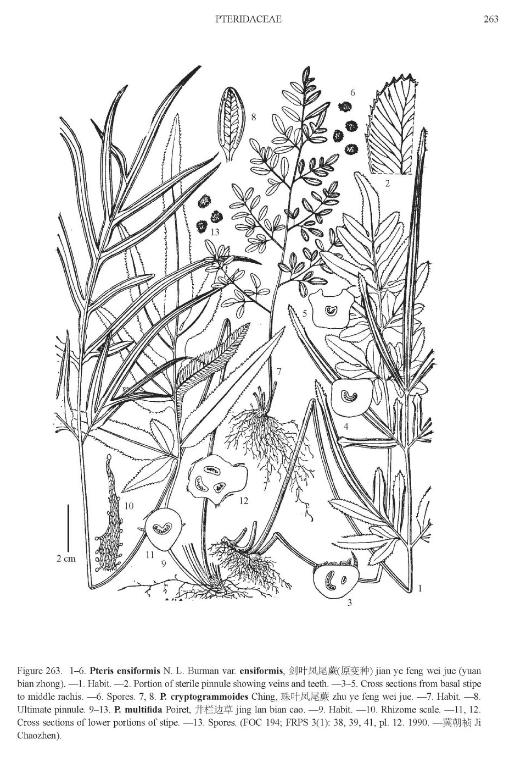
Pteris ensiformis East Asia, Malaya, Australia Chongqing, Fujian, Guangdong, Guangxi, SW Guizhou, Hainan, S Jiangxi, Sichuan, Taiwan, S Yunnan, S Zhejiang [Bhutan, Cambodia, N India, Japan (Ryukyu Islands), Laos, Malaysia, Myanmar, Nepal, Sri Lanka, Thailand, Vietnam; Australia, Pacific islands (Fiji, Polynesia)]. 剑叶凤尾蕨 |
Plants 30-50 cm tall. Rhizome ascending or prostrate, slender, 4-5 mm in diam., apex with black-brown scales. Fronds dense, dimorphic; sterile fronds 1.5-2(-3) cm apart, shorter than fertile fronds. |
|
The Brakes (Pteris) Propagation: By spores sown on fine sandy peat in well-drained pans in temperature 80F (27C) at any time; dwarf species by division of plants, October or April. |
Suitable for Terrarium.
Large genus of mostly tropical ferns. The hardy species formerly included here will be found under Pteridium. |
Slender fertile fronds to 20 inches (50 cms), sterile fronds shorter. Wet acidic soils beneath forests, streamsides; 100-1000 m. |
|
|
|
||
Pteris ensiformis cultivars |
|
|
The Brakes (Pteris) Propagation: By spores sown on fine sandy peat in well-drained pans in temperature 80F (27C) at any time; dwarf species by division of plants, October or April. |
Suitable for Terrarium.
Large genus of mostly tropical ferns. The hardy species formerly included here will be found under Pteridium. |
|
|
|
|
||
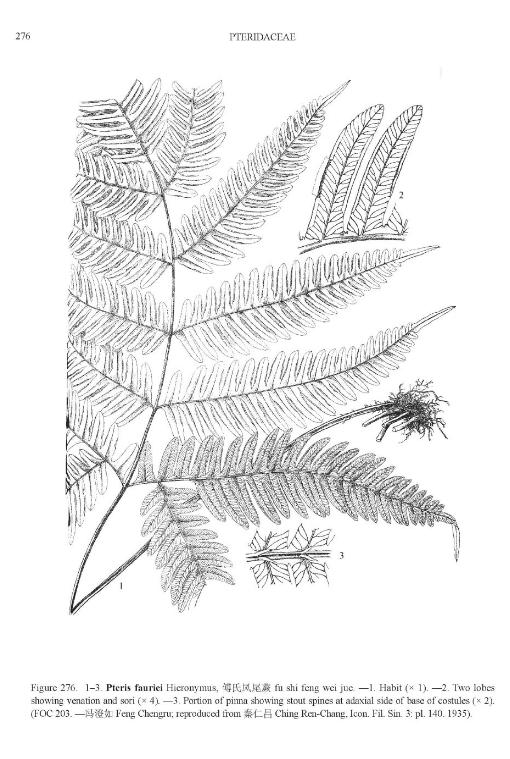
Pteris fauriei Anhui, Fujian, Guangdong, Guangxi, S Guizhou, Hainan, S Hunan, Jiangxi, Taiwan, Xizang, SE Yunnan, Zhejiang [Japan, N Vietnam]. 傅氏凤尾蕨 Fraser-Jenkins (Taxon. Revis. Indian Subcontinental Pteridophytes, 109. 2008) includes Pteris fauriei within P. khasiana (C. B. Clarke) Hieronymus, which would extend the distribution to Bangladesh, NE India, Myanmar, Nepal, Philippines, and Vietnam. Pteris medogensis Ching & S. K Wu (Fl. Xizang. 1: 71-72, t. 16, fig. 1-4. 1983) and P. bomiensis Ching & S. K. Wu (loc. cit.: 72, t. 19) appear to fall within the range of variation accepted for P. fauriei. |
Plants 50-90 cm tall. Rhizome ascending, short, ca. 1 cm in diam., apex densely scaly; scales dark brown, brown at margin, linear-lanceolate, ca. 3 mm. Fronds clustered. |
|
|
|
Acidic soils in forests along valleys; sea level to 800 m. |
Pteris fauriei. Illustration from Flora of China. It may be cited as 'eFloras (2008). Published on the Internet http://www.efloras.org [accessed 16 May 2019]' Missouri Botanical Garden, St. Louis, MO & Harvard University Herbaria, Cambridge, MA. |
||||
Pteris hendersonii |
|
|
|
|
|
|
|
|
||
Pteris kingiana |
|
|
|
|
|
|
|
|
||
Pteris kiuschiunensis Chongqing, Fujian, Guangdong, Guangxi, Guizhou, Hunan, Jiangxi, Sichuan, S Yunnan [Japan]. |
Plants 60-80 cm tall. Rhizome erect, short, ca. 1 cm in diam., apex with yellowish brown scales. Fronds clustered. |
|
|
|
Open forests, near river margins; 300-1200 m. |
|
|
|
||
Pteris longifolia
|
|
|
|
|
|
|
|
|
||
Pteris macilenta |
|
|
|
|
|
|
|
|
||
Pteris microptera |
|
|
|
|
|
|
|
|
||
Pteris multifida (Pteris serrulata) China, Japan Anhui, Chongqing, Fujian, Guangdong, Guangxi, Guizhou, Hebei (Beidaihe), Henan, Hubei, Hunan, Jiangsu, Jiangxi, Shaanxi (Qinling), Shandong (Laoshan, Lushan, Taishan), Sichuan, Taiwan, Zhejiang [Japan (including Ryukyu Islands), S Korea, Philippines, Thailand, Vietnam]. 栏边草 |
Plants 30-45 cm tall. Rhizome erect, short, 1-1.5 cm in diam., apex with black-brown scales. Fronds many, clustered, distinctly dimorphic. |
|
The Brakes (Pteris) Propagation: By spores sown on fine sandy peat in well-drained pans in temperature 80F (27C) at any time; dwarf species by division of plants, October or April. |
Suitable for
Large genus of mostly tropical ferns. The hardy species formerly included here will be found under Pteridium. |
Slender fronds to 18 inches (45 cms) long. On walls or on limestone; below ca. 1000 m. Plant Delights Nursery sells Pteris multifida 'Jade Waterfall' |
Pteris multifida. Illustration from Flora of China. It may be cited as 'eFloras (2008). Published on the Internet http://www.efloras.org [accessed 16 May 2019]' Missouri Botanical Garden, St. Louis, MO & Harvard University Herbaria, Cambridge, MA. |
||||
Pteris multifida cultivars |
|
|
|
|
|
|
|
|
||
Pteris nipponica C Taiwan [Japan, S Korea]. 日本凤尾蕨 Plants of this species were originally treated as a cultivar of Pteris cretica by Japanese botanists. |
Plants medium-sized, evergreen. Rhizome shortly creeping. Fronds closely spaced. |
|
|
|
Exposed on walls; ca. 1200 m. |
|
|
|
||
Pteris orientalis |
|
|
|
|
|
|
|
|
||
Pteris pacifica |
|
|
|
|
|
|
|
|
||
Pteris propinqua |
|
|
|
|
|
|
|
|
||
Pteris pteridioides |
|
|
|
|
|
|
|
|
||
Pteris quadriaurita |
|
|
|
|
|
|
|
|
||
Pteris ryukyuensis |
|
|
|
|
|
|
|
|
||
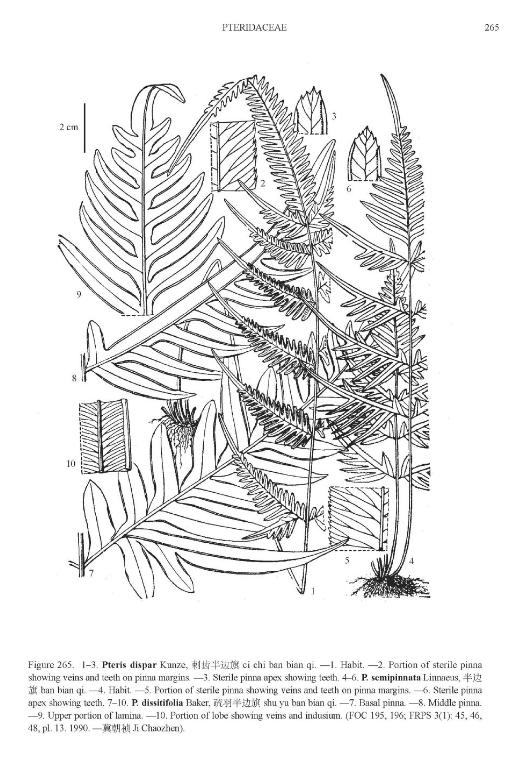
Pteris semipinnata Fujian, Guangdong, Guangxi, S Guizhou (Ceheng, Sandu), Hunan, S Jiangxi (Anyuan, Xunwu), Sichuan (Leshan), Taiwan, S Yunnan [Bhutan, N India, Indonesia (Borneo), Japan (Ryukyu Islands), Laos, Malaysia, Myanmar, Nepal, Philippines, Sri Lanka, Thailand, Vietnam]. 半边旗 Pteris semipinnata is different from P. dispar in shape and distribution. The former is primarily distributed in tropical areas, while P. dispar is primarily distributed in subtropical and northern tropical areas. Both are in Fujian and Taiwan, but any intersecting types have not been seen. |
Plants 35-80(-120) cm tall. Rhizome long creeping, 1-1.5 cm in diam., apex with blackish brown scales; scales also at base of stipes. Fronds clustered. |
|
|
|
Acidic soil in open forests, by streams or rocks; below ca. 900 m. |
Pteris semipinnata. Illustration from Flora of China. It may be cited as 'eFloras (2008). Published on the Internet http://www.efloras.org [accessed 16 May 2019]' Missouri Botanical Garden, St. Louis, MO & Harvard University Herbaria, Cambridge, MA. |
||||
Pteris tremula New Zealand, Australia |
|
|
The Brakes (Pteris) Propagation: By spores sown on fine sandy peat in well-drained pans in temperature 80F (27C) at any time; dwarf species by division of plants, October or April. |
Suitable for House Fern.
Large genus of mostly tropical ferns. The hardy species formerly included here will be found under Pteridium. |
Fronds bright green to 36 inches (90 cms) long. |
|
|
|
||
Pteris tricolor |
|
|
|
|
|
|
|
|
||
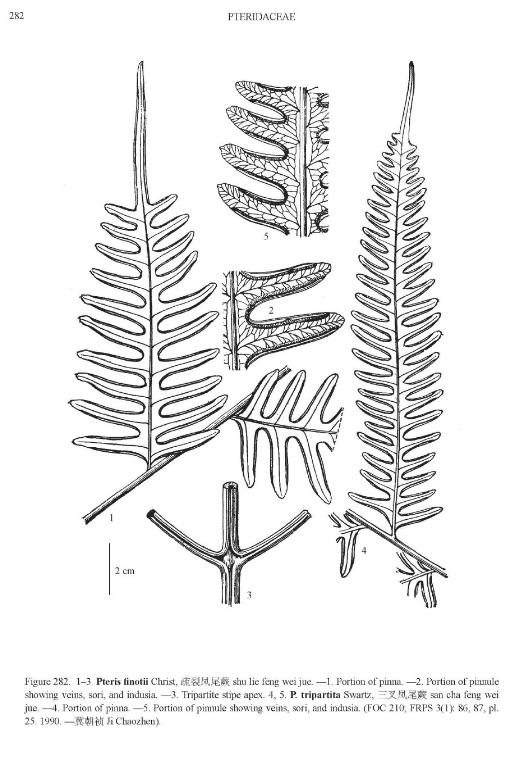
Pteris tripartita (Litobrochia marginata ; Guangdong, Guangxi (Baise, Napo), Hainan (Lingshui), Hunan (Shimen), ?Taiwan [India, Indonesia, Malaysia, Philippines, Sri Lanka, Thailand, Vietnam; Africa, Australia, Madagascar, Pacific islands (Polynesia), South America (Brazil)]. 三叉凤尾蕨 |
Plants more than 2 m tall. Rhizome erect, short, ca. 2 cm in diam., apex with gray-brown scales. Fronds clustered. |
|
|
|
|
Pteris tripartita. Illustration from Flora of China. It may be cited as 'eFloras (2008). Published on the Internet http://www.efloras.org [accessed 16 May 2019]' Missouri Botanical Garden, St. Louis, MO & Harvard University Herbaria, Cambridge, MA. |
||||
Pteris umbrosa |
|
|
|
|
|
|
|
|
||
Pteris vittata (Pteris vittata f. cristata ) Anhui, Fujian, SE Gansu (Kangxian), Guangdong, Guangxi, Guizhou, SW Henan, Hubei, Hunan, Jiangxi, Shaanxi, Sichuan, Taiwan, Xizang, Yunnan, Zhejiang [widely distributed in tropics and subtropics of the Old World]. 蜈蚣草 Plants of Pteris vittata are very different in shape and size, varying according to their habitats. |
Plants (20-)30-100(-150) cm tall. Rhizome erect, short and robust, 2-2.5 cm in diam., woody, apex densely clothed with yellow-brown scales. Fronds clustered. |
|
|
|
Calcareous soils, on limestone, also on stone and on walls; below ca. 2000 m. |
Pteris vittata. Photo by David Boufford from The Biodiversity of the Hengduan Mountains Project.. It may be cited as 'eFloras (2008). Published on the Internet http://www.efloras.org [accessed 16 May 2019]' Missouri Botanical Garden, St. Louis, MO & Harvard University Herbaria, Cambridge, MA.
Pteris vittata. Photo by Susan L. Kelley from The Biodiversity of the Hengduan Mountains Project.. It may be cited as 'eFloras (2008). Published on the Internet http://www.efloras.org [accessed 16 May 2019]' Missouri Botanical Garden, St. Louis, MO & Harvard University Herbaria, Cambridge, MA. |
||||
|
|
|
|
|
|
|
|
|
||
|
If you grow and sell ferns in any country, please tell me so that I can put them on this website and inform others where they can be bought online via mail-order. If you would provide photos and fern details to be only used by me on this website, they would be gratefully received, since I could assume that the photo was a valid one in regard to its name of fern in its filename to that fern in the photo. |
Site design and content copyright ©January 2009. DISCLAIMER: Links to external sites are provided as a courtesy to visitors. Ivydene Horticultural Services are not responsible for the content and/or quality of external web sites linked from this site. |
Fern Grower's Manual by Barbara Joe Hoshizaki & Robbin C. Moran. Revised and Expanded Edition. Published in 2001 by Timber Press, Inc. Reprinted 2002, 2006. ISBN-13:978-0-88192-495-4. |
|
|
|||||

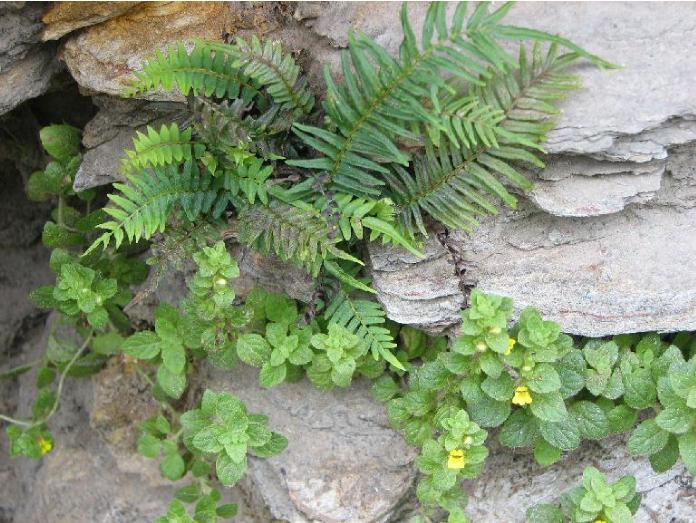
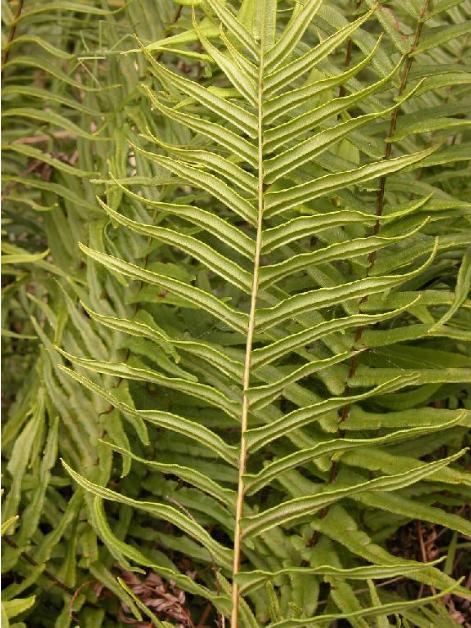


USE OF FERN WITH PHOTOS
using information from Fern Grower's Manual by Barbara Joe Hoshizaki & Robbin C. Moran and
The Encyclopaedia of Ferns An Introduction to Ferns, their Structure, Biology, Economic Importance, Cultivation and Propagation by David L. Jones ISBN 0 88192 054 1
Outdoor Use in
Northeastern United States Zones 3-6
Southeastern United States Zones 6-8
Southern Florida and Hawaii Zones 10-11
Central United States Zones 3-6
Northwestern United States Zones 5-8 with some Zone 9
Southwestern United States Zones 6-9
Coastal Central and Southern California Zones 9-10
Accent
Aquatic 1, 2
Basket 1,
Ferns for Hanging Baskets 2, 3, 4, 5, 6
Ferns for Hanging Baskets with Pendulous Fronds or weeping Growth Habit 7, 8
Bog or Wet-Soil 1,
Ferns for Wet Soils 2, 3
Border and Foundation 1, 2
Grow in Coastal Region
Cold-hardy Ferns 1, 2, 3, 4, 5, 6
Colour in Fern Fronds 1, 2, 3, 4
Conservatory (Stove House) or Heated Greenhouse 1, 2, 3, 4, 5
Drier Soil 1, 2, 3, 4
Grows on Rock (epilithic) 1, 2
Borne on Leaf (epiphyllous) 1, 2
Grows on another Plant (epiphyte) 1, 2
Evergreen and Deciduous
Fronds in Floral Decorations
Ferns for Acid Soil 1,
Lime-hating (Calcifluges) 2, 3, 4, 5
Ferns for Basic or Limestone Soil 1,
Ferns Found on Limestone or Basic Soils (Calciphiles) 2, 3, 4, 5, 6, 7, 8, 9, 10
Ferns for Ground Cover 1,
Ground Cover Ferns 2, 3, 4, 5
Ferns of the Atlantic Fringe with associated plants (1 - Atlantic Cliff-top Grassland, Ledges and Rough Slopes; 2 - Clay Coasts and Dunes of South-East Ireland; 3 - Limestones of Western Atlantic Coasts; 4 - Hebridean Machair; 5 - Horsetail Flushes, Ditches and Stream Margins; 6 - Water Margin Osmunda Habitats; 7 - Western, Low-lying, Wet, Acid Woodlands; 8 - Western, Oak and Oak-Birch Woodlands and Ravines, in the UK and Ireland)
Ferns in Coastal District with associated plants (Hard Rock Cliffs, Soft Rock Cliffs, Clay Coasts, or Coastal Sand-Dunes in the UK)
Ferns of Grasslands and Rock Outcrops (Grasslands; Rocks, Quarries and Mines in the UK)
Ferns of Heath and Moorland with associated plants (1 - Bracken Heath; 2 - Ferns of Moist Heathland Slopes and Margins of Rills and Streams; 3 - Heathland Horsetails, 4 - Heathland Clubmosses, in the UK)
Ferns of Lower Mountain Habitats with associated plants (1 - Upland Slopes and Screes; 2 - Base-rich, Upland Springs and Flushes; 3 - Base-rich, Upland, Streamside Sands and Gravels; 4 - Juniper Shrub Woodland, in the UK)
Ferns for Man-Made Landscapes with associated plants (South-western Hedgebanks, Hedgerows and Ditches, Walls and Stonework, Water Mills and Wells, Lime Kilns and abandoned Lime-Workings, Pit heaps and Shale Bings, Canals, Railways and Their Environs in the UK)
Ferns of Upper Mountain Habitats with associated plants (1 - High Mountain, Basic Cliffs and Ledges; 2 - High, Cliff Gullies; 3 - High Mountain Corries, Snow Patches and Fern beds; 4 - Ridges, Plateaux and High Summits, in the UK)
Ferns for Wetlands with associated plants (1- Ponds, Flooded Mineral Workings and Wet Heathland Hollows; 2 - Lakes and Reservoirs; 3 - Fens; 4 - Ferns of the Norfolk Broads' Fens; 5 - Willow Epiphytes in the UK)
Ferns in Woodland with associated plants (1 - Dry, Lowland, Deciduous Woodland; 2 - Inland, Limestone, Valley Woodland; 3 - Base-rich Clay, Valley Woodland; 4 - Basic, Spring-fed Woodland; 5 - Ravine Woodland on Mixed Rock-types; 6 - Native Pine Forest in the UK)
Ferns in Hedges or Hedgebanks
Outdoor Containers 1, 2, 3, 4, 5, 6, 7
Rapidly Growing Fern 1, 2
Resurrection Fern
Rock Garden and Wall Ferns 1, 2, 3, 4, 5
Shade Tolerant 1, 2, 3, 4
Slowly Growing Fern
Sun Tolerant 1, 2, 3, 4
House Fern in Trough Garden 1,
Fern Suitable for
Indoor Decoration 2, 3, 4, 5, 6
House Fern in Terrarium, Wardian Case or
Bottle Garden 1,
Ferns suitable for Terrariums, Wardian Cases 2, 3, 4,
5, 6
Grow in Woodlands 1, 2, 3, 4
TYPE OF FERN TO GROW WITH PHOTOS
using information from
Fern Grower's Manual by Barbara Joe Hoshizaki & Robbin C. Moran and
The Encyclopaedia of Ferns An Introduction to Ferns, their Structure, Biology, Economic Importance, Cultivation and Propagation by David L. Jones ISBN 0 88192 054 1
Aquatic Ferns (Azolla, Ceratopteris, Marsilea, Pilularia, Regnellidium, Salvinia)
Boston ferns (Nephrolepis exaltata), Fishbone ferns (Nephrolepis cordifolia), Lace ferns and Sword ferns
Cloak, Lip, Hand Ferns and their Hardy Relatives (Bommeria, Cheilanthes, Doryopteris, Gymnopteris, Hemionitis, Notholaena, Paraceterach, Pellae, Pleurosorus, Quercifilix) 1,
2, 3
Davallia Ferns (Araiostegia, Davallia, Davallodes, Gymno-grammitis, Humata, Leucostegia, Scyphularia, Trogostolon) 1, 2
Fern Allies (Psilotums or Whisk Ferns, Lycopodiums or Ground Pines, Selaginellas or Spike Mosses, and Equisetums, Horsetails or Scouring Rushes) 1, 2
Filmy and Crepe Ferns (Hymenophyllum, Trichomanes, Leptopteris) 1, 2
Lacy Ground Ferns (Culcita, Dennstaedtia, Histiopteris, Hypolepis, Leptolepia, Microlepia, Paesia, Pteridium) 1, 2
Lady Ferns and Their Allies (Allantodia, Athyrium, Diplazium, Lunathyrium, Pseudo-cystopteris, Callipteris, Cornopteris, Cystopteris) 1, 2
Maidenhair Ferns (Adiantum) 1, 2
Miscellaneous Ferns (Acrostichum, Actiniopteris, Anemia, Anogramma, Anopteris, Blotiella, Bolbitis, Christella, Coniogramma, Cryptogramma, Ctenitis, Cyclosorus, Didymochlaena, Dipteris, Elaphoglossum, Equisetum, Gymnocarpium, Llavea, Lonchitis, Lygodium, Macrothelypteris, Oeontrichia, Oleandra, Onoclea, Onychium, Oreopteris, Parathelypteris, Phegopteris, Photinopteris, Pityrogramma, Pneumatopteris, Psilotum, Stenochlaena, Thelypteris, Vittaria)
1, 2, 3, 4 including Fern Allies of Equisetum and Psilotum or Whisk Ferns
Polypodium Ferns and Relatives (Anarthropteris, Belvisia, Campyloneurum, Colysis, Crypsinus, Dictymia, Gonphlebium, Lecanopteris, Lemmaphyllum, Lexogramme, Microgramma, Microsorum, Niphidium, Phlebodium, Phymatosurus, Pleopeltis, Polypodium, Pyrrosia, Selliguea) 1, 2, 3
Primitive Ferns and Fern Oddities (Angiopteris, Botrychium, Christensenia, Danaea, Helminthostachys, Marattia, Ophioglossum, Osmunda and Todea)
Scrambling, Umbrella, Coral and Pouch Ferns (Dicranopteris, Diploptergium, Gleichenia, Sticherus)
Shield, Buckler, Holly Ferns and their Relatives (Arachniodes, Cyrtomium, Dryopteris, Lastreopsis, Matteuccia, Polystichum, Rumohra, Tectaria and Woodsia) 1, 2, 3, 4
Spleenworts Ferns (Asplenium) 1, 2, 3
Staghorns, Elkhorns and other large epiphytes (Aglaomorpha, Drynaria, Merinthosorus, Platycerium, Pseudodrynaria) 1, 2
Fern Allies - Tassel Ferns and Clubmosses (Lycopodium)
The Brakes (Pteris) 1, 2
Tree Ferns (Cibotium, Cnemidaria, Cyathea, Dicksonia, Nephelea and Trichipteris) 1, 2
Water, Hard, Rasp and Chain Ferns (Blechnum, Doodia, Woodwardia, Sadleria) 1, 2
Xerophytic Ferns (Actinopteris, Astrolepis, Cheilanthes, Doryopteris, Notholaena, Pellaea, Pityrogramma) 1, 2
Topic
|
|
|
|
STAGE 4C CULTIVATION, POSITION, USE GALLERY
Cultivation Requirements of Plant |
|
Outdoor / Garden Cultivation |
|
Indoor / House Cultivation |
|
Cool Greenhouse (and Alpine House) Cultivation with artificial heating in the Winter |
|
Conservatory Cultivation with heating throughout the year |
|
Stovehouse Cultivation with heating throughout the year for Tropical Plants |
|
|
|
Sun Aspect |
|
|
|
Soil Type |
|
|
|
Soil Moisture |
|
|
|
Position for Plant |
|
Ground Cover 0-24 inches (0-60 cms) |
|
Ground Cover 24-72 inches (60-180 cms) |
|
Ground Cover Over 72 inches (180 cms) |
|
1, 2, |
|
|
|
Use of Plant |
|
|
|
STAGE 4D Plant Foliage |
|
|
|
Flower Shape |
|
Number of Flower Petals |
|
|
|
Flower Shape - Simple |
|
|
|
|
|
|
Flower Shape - Elaborated |
|
|
|
Natural Arrangements |
|
|
|
STAGE 4D |
|
|
|
|
|
Form |
|
|
|
|
|
STAGE 1
Fragrant Plants adds the use of another of your 5 senses in your garden:- |
|
|
|
STAGE 2 Fan-trained Shape From Rhododendrons, boxwood, azaleas, clematis, novelties, bay trees, hardy plants, evergreens : novelties bulbs, cannas novelties, palms, araucarias, ferns, vines, orchids, flowering shrubs, ornamental grasses and trees book, via Wikimedia Commons |
|
Ramblers Scramblers & Twiners by Michael Jefferson-Brown (ISBN 0 - 7153 - 0942 - 0) describes how to choose, plant and nurture over 500 high-performance climbing plants and wall shrubs, so that more can be made of your garden if you think not just laterally on the ground but use the vertical support structures including the house as well. The Gardener's Illustrated Encyclopedia of Climbers & Wall Shrubs - A Guide to more than 2000 varieties including Roses, Clematis and Fruit Trees by Brian Davis. (ISBN 0-670-82929-3) provides the lists for 'Choosing the right Shrub or Climber' together with Average Height and Spread after 5 years, 10 years and 20 years. |
|
|
|
STAGE 2
|
|
|
|
STAGE 4D Trees and Shrubs suitable for Clay Soils (neutral to slightly acid) Trees and Shrubs suitable for Dry Acid Soils Trees and Shrubs suitable for Shallow Soil over Chalk Trees and Shrubs tolerant of both extreme Acidity and Alkalinity Trees and Shrubs suitable for Damp Sites Trees and Shrubs suitable for Industrial Areas Trees and Shrubs suitable for Cold Exposed Areas Trees and Shrubs suitable for Seaside Areas Shrubs suitable for Heavy Shade Shrubs and Climbers suitable for NORTH- and EAST-facing Walls Shrubs suitable for Ground Cover Trees and Shrubs of Upright or Fastigiate Habit Trees and Shrubs with Ornamental Bark or Twigs Trees and Shrubs with Bold Foliage Trees and Shrubs for Autumn Colour Trees and Shrubs with Red or Purple Foliage Trees and Shrubs with Golden or Yellow Foliage Trees and Shrubs with Grey or Silver Foliage Trees and Shrubs with Variegated Foliage Trees and Shrubs bearing Ornamental Fruit Trees and Shrubs with Fragrant or Scented Flowers Trees and Shrubs with Aromatic Foliage Flowering Trees and Shrubs for Every Month:- |
|


.jpg?uselang=en-gb)
Use of Fern
|
Use of Fern
See
If you grow and sell ferns, please tell me so that I can put them on this website and inform others where they can be bought online via mail-order. The remarkable sex life of ferns:-
|
||||||||||||||||||||||||||||||||||||||||||||||||||||||||||||||||||||||||||||||||||||||||||||||||||||||||||||||||||||||||||||||||||||||||||||||||||||||||||||||||||||||||||||||||||||||||||||||||||||||||||||||||||||||||||||||||||||||||||||||||||||||||||||||||||||||||||||||||||||||||||||||||||||||||||||||||||||||||||||||||||||||||||||||||||||||||||||||||||||||||||||||||||||||||||||||||||||||||||||||||||||||||||||||||||||||||||||||||||||||||||||||||||||||||||||||||||||||||||||||||||||||||||||||||||||||||||||||||||||||||||||||||||||||||||||||||||||||||||||||||||||||||||||||||||||||||||||||||||||||||||||||||||||||||||||||||||||||||||||||||||||||||||||||||||||||||||||||||||||||||||||||||||||||||||||||||||||||||||||||||||||||||||||||||||||||||||||||||||||||||||||||||||||||||||||||||||||||||||||||||||||||||||||||||||||||||||||||||||||||||||||||||||||||||||||||||||||||||||||||||||||||||||||||||||||||||||||||||||||||||||||||||||||||||||||||||||||||||||||||||||||||||||||||||||||||||||||||||||||||
|
|
||||||||||||||||||||||||||||||||||||||||||||||||||||||||||||||||||||||||||||||||||||||||||||||||||||||||||||||||||||||||||||||||||||||||||||||||||||||||||||||||||||||||||||||||||||||||||||||||||||||||||||||||||||||||||||||||||||||||||||||||||||||||||||||||||||||||||||||||||||||||||||||||||||||||||||||||||||||||||||||||||||||||||||||||||||||||||||||||||||||||||||||||||||||||||||||||||||||||||||||||||||||||||||||||||||||||||||||||||||||||||||||||||||||||||||||||||||||||||||||||||||||||||||||||||||||||||||||||||||||||||||||||||||||||||||||||||||||||||||||||||||||||||||||||||||||||||||||||||||||||||||||||||||||||||||||||||||||||||||||||||||||||||||||||||||||||||||||||||||||||||||||||||||||||||||||||||||||||||||||||||||||||||||||||||||||||||||||||||||||||||||||||||||||||||||||||||||||||||||||||||||||||||||||||||||||||||||||||||||||||||||||||||||||||||||||||||||||||||||||||||||||||||||||||||||||||||||||||||||||||||||||||||||||||||||||||||||||||||||||||||||||||||||||||||||||||||||||||||||||