|
|||||||
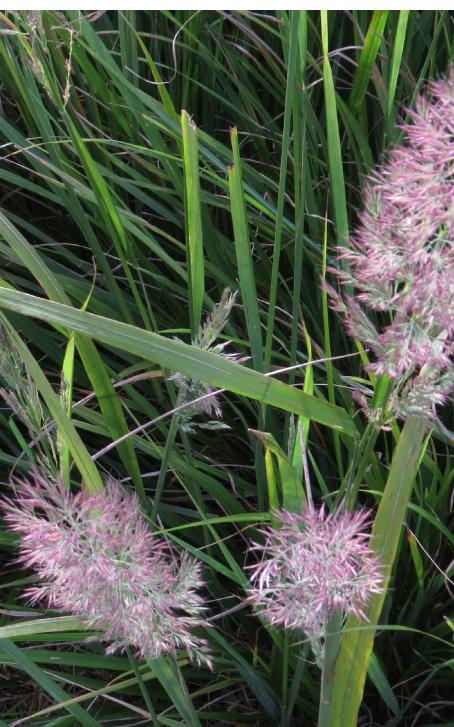
Inflorescences from Mixed Borders at RHS Wisley. Photo from Chris Garnons-Williams on 16 September 2013. |
|||||||
Plant Name |
Calamagrostis brachytricha "The word "Calamagrostis" is derived from the Greek word kalamos (reed) and agrostis (a kind of grass). They are referred to generally as Reed Grasses" from Plants to Plant. |
||||||
Common Name |
Korean Feather Reed Grass, Foxtail Grass |
||||||
Soil |
Chalk, Loam, Sand, Clay (Acidic Alkaline Neutral) |
||||||
Sun Aspect |
Full Sun |
||||||
Soil Moisture |
Moist, humus-rich soil, and Well-drained |
||||||
Plant Type |
Perennial Grass |
||||||
Height x Spread in inches (cms) |
60 x 36 (150 x 90) |
||||||
Foliage |
Grey-Green |
||||||
Flower Shape, Natural Arrangement, Number of Petals and Flower Colour in Month(s). Seed |
Tall, fluffy flower heads that are Silvery-Grey with Pinkish-Purple tints in June-August |
||||||
Comment |
Clump-forming upright Form. "A useful, clump-forming, upright grass that will thrive in sun and partial shade, this is grown for its tall, fluffy flower heads that are silvery-grey with pinkish-purple tints. Creating a gently arching fountain of grey-green foliage, which takes on buttery shades in autumn. The emerging growth can be a bit tatty, so place it in the middle of the border. Its best planted in full sun as it tends to flop over more in shade. It has been given the Award of Garden Merit by the Royal Horticultural Society. Cut back to ground level in late winter before the new growth appears." from Crocus.
"In late summer and early autumn, narrow flowerheads are borne on tall stems that open up into fluffy silver-grey plumes of pinky purple flowers. These last over winter, above the arching leaves, and give rise to an alternative common name of foxtail grass. This plant is from moist woodlands and woodland edges in eastern Asia, but is tolerant of a range of conditions as long as the moisture levels are sufficient. It makes a good specimen or container plant, and is great when grown in drifts. It also dries well. It has a tendency to self-seed prolifically in suitable conditions." from RHS.
"Calamagrostis arundinacea var. brachytricha, unlike most of the reed grasses, performs well in light shade. It does best in moist, fertile soil in full sun but in hot climates needs light or afternoon shade. C. brachytricha is tolerant of a wide range of soils and growing conditions, although adequate moisture is necessary if grown in the full sun. Propagate by seed or division of clumps every few years. Cut stems down to the ground in early spring before new growth occurs. Most effective as a specimen, in containers or perennial border. " from North Creek Nurseries - "Being wholesale to the trade only and we do not sell directly to the public, we can offer a wealth of plant information, resources and ideas to keep your gardens humming with life. Find your favorite online retailer or local retail nursery here, and be sure to ask nationwide for our American Beauties Native Plants® (See their Native Plant Library) brand at your nearest independent garden center".
"Great Grasses for Tricky Landscapes" by Hoffman Nursery.
Available from
Crocus , If you are having a difficult time trying to decide which ornamental grasses to choose for your garden, a great place to start is with our Grass Comparison Chart and / or the Landscape Uses page. The latter is available for willows as well. There we have all the grasses listed, with brief information about each one. You can easily compare them to each other for height, bloom time, hardiness, drought tolerance, preferred conditions, etc." and Seed available from Plant World Seeds. |
||||||
Wildlife problems with lawns in America and Water Wise Garden Design can help to eradicate usage of pesticide in your garden |
"There are a lot of lawns in the United States. Lawns are the 5th largest “crop” in the lower 48. After corn, wheat, soybean, and hay, we devote more land area to lawn than to any other cultivated plant. This is bad news for wildlife and for ourselves. The application of pesticides to lawns is typically 20 times greater than pesticide application to farm crops. Lawns are an American obsession that the rest of the world doesn’t share. We Americans spend more than $40 billion per year on lawn installation, products, equipment, and the lawn-service industry. Gasoline powered mowers, blowers and trimmers account for 5% of urban air pollution. Even with the efforts of municipal garbage and recycling collectors and processors, and the availability of yard waste cans, the contents of which are turned into organic compost, grass clippings and debris from ornamental plantings account for 5% of our national waste." from Water Wise Garden Design.
|
||||||
|
|||||||
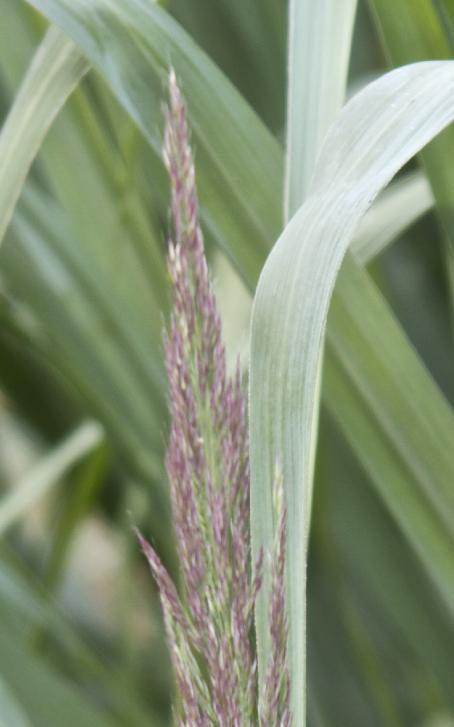
Juvenile Inflorescence buds from bed alongside Main Cafe lawn at RHS Wisley. Photo from H. Kavanagh on 19 August 2013. |
|||||||
|
|||||||
Juvenile Inflorescence buds from bed alongside Main Cafe lawn at RHS Wisley. Photo from H. Kavanagh on 19 August 2013. |
|||||||
|
|||||||
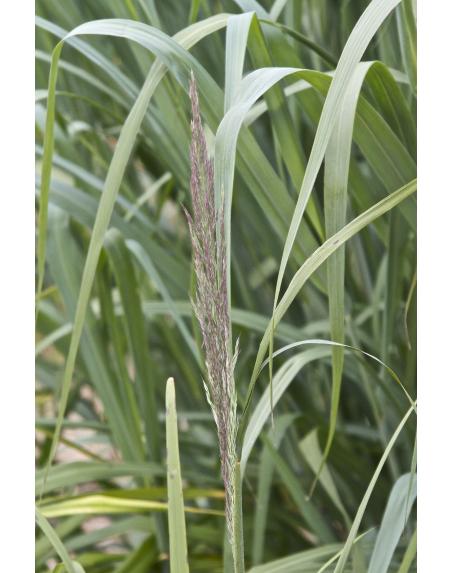
Maturing Inflorescence buds from Mixed Borders at RHS Wisley. Photo from Chris Garnons-Williams on 16 September 2013. |
|||||||
|
|||||||
Foliage from bed alongside Main Cafe lawn at RHS Wisley. Photo from H. Kavanagh on 19 August 2013. |
|||||||
|
|||||||
Winter Form from Mixed Borders at RHS Wisley. Photo from H. Kavanagh on 20 January 2013. |
|||||||
|
|||||||
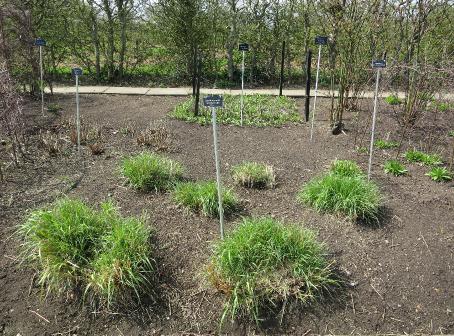
Spring Form from Mixed Borders at RHS Wisley. Photo from Chris Garnons-Williams on 27 April 2013. |
|||||||
|
|||||||
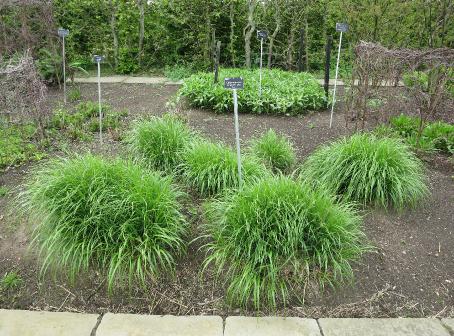
Spring Form from Mixed Borders at RHS Wisley. Photo from Chris Garnons-Williams on 15 May 2013. |
|||||||
|
|||||||
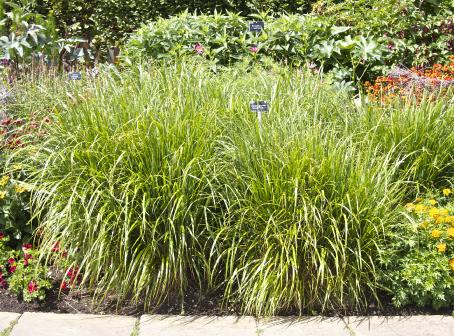
Late Summer Form from Mixed Borders at RHS Wisley. Photo from H. Kavanagh on 21 August 2013. |
|||||||
|
|||||||
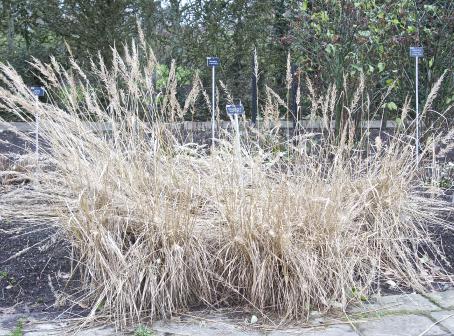
Autumn Form from Mixed Borders at RHS Wisley. Photo from Chris Garnons-Williams on 16 September 2013. |
|||||||
|
|||||||
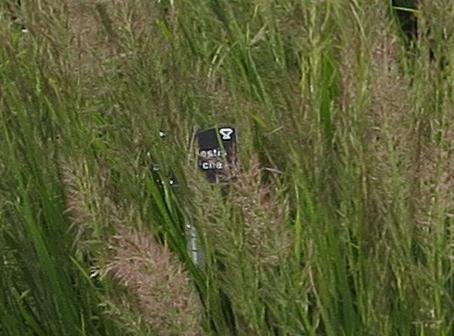
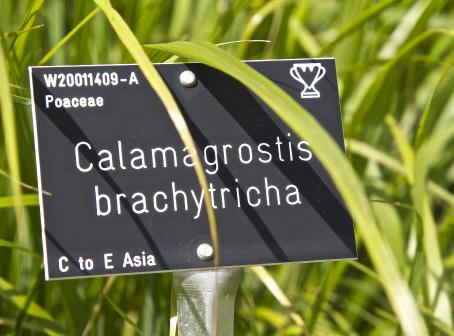
Plant Label from Expanded image of above Autumn Form from Mixed Borders at RHS Wisley. Surprise, Surprise - Plant label in middle of plants has now almost been hidden from view when this grass is producing its inflorescences. Photo from Chris Garnons-Williams on 16 September 2013. |
|||||||
|
|||||||
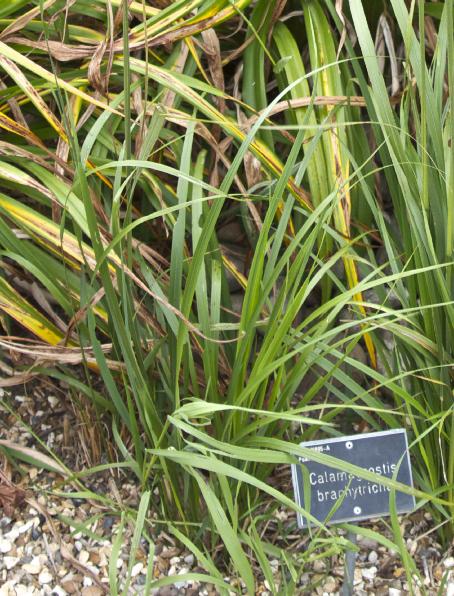
Plant Label from Mixed Borders at RHS Wisley. Photo from Chris Garnons-Williams on 11 April 2013. |
|||||||
|
|||||||
|
|
|
|
|
|
|
|
Number of Flower Petals |
|||||||
|
|
|
|
|
|
|
|
Flower Shape - Simple |
|||||||
|
|
|
|
|
|
|
|
Flower Shape - Simple |
|
|
|
||||
|
|
|
|
|
|
|
|
Flower Shape - Elabor-ated |
|||||||
|
|
|
|
|
|
|
|
Flower Shape - Elabor-ated |
|
|
|
||||
|
 |
 |
|
|
|
|
 |
Natural Arrange-ments |
|||||||
At the Commital for Marilyn Lewis 1954-April 2014 some of Marilyn's Recipes were published pre and post in the Order of Service provided for the attendees: This is her Potato Goulash for serving to 4 Vegetarians:- 8 Ounces Onion, thinly sliced, 1. Fry onions in oil and margarine in large pan. 2. Add potatoes with the paprika and stir. Add the water and salt. Cover and cook slowly for 20 minutes. 3. Stir in flour (blended with 3-4 tablespoons of water) and Caraway seeds. Cook 1-2 minutes. 4. Remove from heat. Stir in Sour Cream and put into casserole. Sprinkle with chopped chives and sliced eggs.
Unfortunately; we the generation who finished their education in Britain before AD 2000 still use ounces - International avoirdupois ounces - despite the following statement - "On January 1, 2000, it ceased to be a legal unit of measure within the United Kingdom for economic, health, safety or administrative purposes". Due to the British Government overspending for the last 4 years at a rate of £3805.18 a second, there are insufficient funds to educate our illiterate about that last statement concerning the legality of using the ounce.
10 years later - in April 2024 - from first publishing this page, UK National Debt was roughly £1,080,000,000,000 in 2009, then Conservatives came into government in 2010. £2,654,300,000,000 British 30 year Gilt is 4.379% annually on 12 March 2024. UK Goverment collected £788,600,000,000 in taxes in 2022 to 2023, an increase of 10.2% from the year before. "The Local Government Association recently reported that one in five councils could be in severe financial hardship within two years and a report from the Local Government Information Unit (LGIU) this week reported that more than 50 per cent of councils are saying it is likely they would issue a Section 114 notice in the next five years. Medway has seen a sharp reduction in revenue support grant from government - £85million to around £7million since 2010 – despite a continuing increase in service demand and inflationary costs.
|
|||||||




MIXED BORDER DESIGN GALLERY PAGES
FLOWER COLOUR RANGE IN 71 PARTS OF MIXED BORDER DURING |
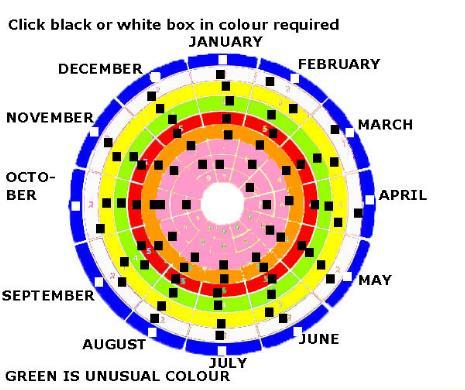
7 Flower Colours per Month in Colour Wheel below in the MIXED BORDERS DESIGN Gallery. Click on Black or White box in Colour of Month. |
||||||||
|
|||||||||
|
It is worth remembering that the links to external sites were valid on the day that I created that link, but may no longer be valid as Father Time moves on! |
||||||||
MIXED BORDER OTHER PLANTS GALLERY PAGES Site Map of pages with content (o) Introduction - |
Other Permanent Plants Height from Text Border for the |
||||||||
Blue = 0-24 inches |
Green = 24-72 inches |
Red = 72+ inches |
|||||||
Bedding Plants Soil Moisture from Text Background |
|||||||||
Wet Soil |
Moist Soil |
Dry Soil |
|||||||
Click on thumbnail to add the Plant Description Page of the Bedding Plants named in the Text box below that photo. |
|||||||||
|
|||||||||
MIXED BORDER OTHER PLANT INDEX |
|||||||||
Other Plant Name with link to its Description Page |
Flower Colour with link to Design of East Border or |
Flowering Months with link to Mixed Borders Flower Colour per Month Pages |
Flower Thumbnail |
Height x Spread in inches (cms) |
Foliage Colour with link to Mixed Borders Foliage Colour Page |
Foliage Thumbnail |
Comment |
||
Bamboo |
|||||||||
|
|
|
|
|
|
|
|
||
Bulb |
|||||||||
|
60 x 24 |
|
5 other Agapanthus in Herbaceous Perennial Gallery |
||||||
|
24 x 8 |
|
74 other Allium in Allium and Anemone Gallery |
||||||
Green, then Purple and ages Reddish-Purple |
|
24 x 3 |
Strap-like, Mid-Green |
|
|
||||
Red and green petals spotted with black |
Aug-Sep |
|
40 x 18 |
Light Green |
|
|
|||
Opening Orange fades to Pink |
August, September, October |
|
35 x 23 |
Erect, narrow, sword-shaped and Dark Green |
|
100 Crocosmia at Trecanna Nursery |
|||
|
36 x 18 |
Upright, pleated, wide, lance-shaped, mid Green leaves |
|
|
|||||
|
should be named Ornithogalum candicans |
|
48 x 16 |
Strap-shaped and Mid-Green |
|
Other Southern African Orni-thogalum species that originate in southern Africa |
||||
Climber |
|||||||||
Clematis See Description Page also in Clematis Climber Gallery |
|
120 x 72 |
Grey-Green |
|
See 70 other Clematis climbers in Clematis Climber Gallery and further data on Clematis |
||||
Clematis |
|
120-180 x 36 |
Dark Green |
|
321 Clematis at Haw-thornes Nursery |
||||
|
60 x 20 |
Dark Green |
|
|
|||||
Blue, Violet, Lilac, Lavender |
|
100 x 40 |
Lance-shaped Dark Green |
|
|
||||
Clematis 'Elvan' |
"All Clematis fall into one of 3 distinct pruning groups: No Prune (Group 1), Light Prune (Group 2), and Hard Prune (Group 3). Group 1: Early Flowering. Typically blooming in winter and spring, these varieties flower on the previous year's growth only, so if you need to remove damaged stems or control the size of the plant, the best time would be as soon as they have finished flowering. Included in this group are Alpina, Macropetala, Montana, and Evergreen varieties. Group 2: Large Flowers. Typically larger flowers grow out on new shoots from last year's growth in late spring and summer. Some of these will occasionally display a second bloom at the tips of the current year's growth in late summer and autumn. These varieties should be pruned in spring, right back to where there are strong and healthy buds, before they start their active growth period. New flowering stems will be produced from this architecture of previous growth. Group 3: Late Flowering. Group 3 Clematis only flower on current year's growth. These blooms tend to display from summer through to late autumn. These varieties are arguably the easiest to prune, as you basically cut it right down to about 20cm (8ins) above ground level in spring before they begin their active growth period, removing all of the previous year's growth." from Primrose who have produced a new method of raising "Kids in our planters". |
If this climber flowered after May 2013, then I could not identify it or see its Plant Label. See Clematis 'Elvan' Des-cription Page in Clematis Climbers Gallery |
|||||||
Clematis |
If this climber flowered after April 2013, then I could not identify it or see its Plant Label. See Clematis 'Etoile Violette' Des-cription Page in Clematis Climbers Gallery |
||||||||
Purple fades to Blue |
|
60 x 60 |
Dark Green |
|
Where is the American Clematis Society? |
||||
|
See Description Page also in Clematis Climber Gallery |
|
168 x 36 |
Pale to Mid-Green |
|
Clem-atis.com focuses on Clematis varieties which are available and suitable for the North American garden including this variety |
||||
White with Pink tinge |
|
72 x 36 |
Dark Green |
|
British Clematis Society awarded 'Com-mended Certificate' to this Clematis |
||||
Clematis 'Kermesina' |
Unable to locate plant label to take photos of its foliage or flowers after 4 March 2013 |
|
|||||||
Clematis 'Madame Julia Correvon' See Description Page also in Clematis Climber Gallery |
|
96-120 x 36 |
Dark Green |
|
Sag-amihara Green Association for Clematis in Japan |
||||
Clematis 'Pink Ice' |
Unable to locate plant label to take photos of its foliage or flowers after 15 May 2013 |
|
Fact Sheet on Clematis from Gardening in Australia |
||||||
Clematis 'Purpurea Plena Elegans' |
Unable to locate plant label to take photos of its foliage or flowers after 13 April 2013 Chelone glabra black plant label on left and Clematis 'Purpurea Plena Elegans' black plant label on right |
|
Clematis Nomen-clatural Standards List from the Inter-national Clematis Society |
||||||
Clematis Rosemoor 'Evipo002' |
Unable to locate plant label to take photos of its foliage or flowers after 13 April 2013 Hemerocallis lilio-asphodelus black plant label on right and Clematis Rosemoor 'Evipo002' black plant label in middle |
|
|
||||||
|
180 x 60 |
Mid-Green |
|
|
|||||
Clematis 'Ruutel' |
Unable to locate plant label to take photos of its foliage or flowers after 4 March 2013. Since its Birch Branch Support structure has not been replaced, It may be that this climber position was not going to be there in 2013 summer season. |
|
|
||||||
Violet Blue ages to Purple |
|
120 x 60 |
Dark Green |
|
|
||||
Clematis x aromatica |
Unable to locate plant label to take photos of its foliage or flowers after 15 May 2013 |
|
|
||||||
|
80 x 40 |
Pale Green |
|
|
|||||
|
80 x 36 |
Grey-Green |
|
|
|||||
Conifer |
|||||||||
|
|
|
|
|
|
|
|
||
Dediduous Shrub |
|||||||||
|
60 x 60 |
Grey-Green |
|
|
|||||
|
Unable to locate plant label to take photos of its foliage or flowers after 15 May 2013. |
|
The Trials Report of 2008-2010 on Buddleja davidii and its close hybrids of the RHS provides useful data including the require-ment for hard pruning. The Panel co-opted three genus special-ists, who are all national collection holders of Buddleja. They were; Peter Moore (Long-stock Gardens), Anita Allen (Shap-cott Barton Estate) and Andrew Bullock (The Lavender Garden). |
|||||||
Buddleja davidii 'Nanho White Monite' |
Unable to locate plant label to take photos of its foliage or flowers after 15 May 2013. |
|
|||||||
Buddleja davidii 'Peacock' |
Pink to Purple-Pink |
|
60 x 60 |
Medium Green |
|
|
|||
|
120 x 120 |
Large crisp Golden-Yellow leaves in spring. |
|
|
|||||
Cornus alba 'Elegantissima' |
Small, Creamy-White, in flat heads. Unable to see its flowers in May-June or even later in the year. The 3 cornus at the back of the bed are starting to create their spring foliage on 15 May 2013 |
|
Spring pruning at Beech-grove Garden helps you to create what you want to see from a plant. |
||||||
|
The 3 cornus at the back of the bed are now over 6 feet high on 29 August 2013. The plants in front obstruct the view of the cornus behind and thus no photos of the flowers of this cornus were taken in 2013. As a backdrop of variegated green/yellow it may be fine, but in that case why not replace that section of hedge behind it instead. |
|
|
||||||
|
200 x 200 |
Dark Red-Purple oval leaves and, when the temperature drops, the leaves develop a bright-pink margin before becoming scarlet. |
|
|
|||||
Scarlet Sepals and Purple Petals |
|
44 x 44 |
Slender deep Green |
|
Hardy Fuchsia List for the Showbench from the Fuchsia Societies in the UK |
||||
Scarlet Sepals and Purple Petals |
|
80 x 120 |
Bronze-tinted Dark Green Spring Foliage becomes Dark Green Foliage in the Summer |
|
There is the American Fuchsia Society , the Australian Fuchsia Society Inc the National Fuchsia Society of New Zealand and there was the Greater Victoria Geranium and Fuchsia Society in Canada |
||||
White with Red base |
|
96 x 60 |
Lobed Dark Green |
|
Inter-national Hibiscus Society list of registered and non-registered cultivars |
||||
|
52 x 60 |
Dark Green |
|
American Hyd-rangea Society with the story of the big Hydrangea that wouldn't bloom. |
|||||
|
200 x 100 |
Toothed Mid to Dark Green |
|
|
|||||
Burgundy, Pink and White |
|
100 x 80 |
Dark Green |
|
|
||||
|
Without the 50 x optical zoom on my current camera, I was unable to take photos of the flowers which were on this shrub on 15 May 2013. This shrub is too far back to enjoy its flowers with the naked eye. |
|
The Peony Society has further details on peonies. |
|||||||
White often tinged with Pink |
|
60 x 60 |
Golden Yellow |
|
|
||||
|
96 x 96 |
Dark Purple ages to Green |
|
|
|||||
Sambucus nigra f. porphyrophylla 'Guincho Purple' |
Pink and White The Plant Label in the middle of this photo of January 2013 is unreadable. The Plant Label has been expanded below. |
|
The photo taken on the bottom right on 15 May 2013 shows that the Sambucus plant label is facing the front. The Yellowish-Green juvenile foliage on the bottom right belongs to Cornus alba 'Aurea' - you can see from its page that it grows quite high and hides the side view of this Sam-bucus Plant Label when that plant is in flower. Since the plant label is difficult to read from the front lawn, this indicates no identity of this plant took place when it was in flower. |
||||||
|
|
||||||||
Sambucus nigra f. porphyrophylla 'Gerda' |
When you look at the panorama photos in East Border Part 19 you will note - by 19 September 2013 - that purple flowers could be seen on the Sambucus but its plant label could not, because of the yellow foliage of the Cornus in front of it. |
|
This photo taken on 15 May 2013 shows the plant label for this burgundy-leaved Sam-bucus in the middle and facing the lawn between the 2 Mixed Borders. The orange juvenile foliage on the left is from Cornus alba 'Aurea'. |
||||||
Deciduous Tree |
|||||||||
Catalpa bignonioides 'Aurea' |
Since no flowers were seen, then no photos of its flowers could be taken in Wisley. |
|
This photo from Bowes-Lyon Rose Garden on 15 June shows no flower bud formation for flowering in July. |
||||||
|
|
|
This photo on 21 August 2013 from East Border Part 25 shows no indication of flowers during July or August. The panorama photos in that page do not indicate any evidence of flowers during 2013 |
||||||
Paulownia tomentosa |
Photo from 4 March 2013 followed by photo of 1 July 2013 with no flowers seen before or afterwards. |
|
|
||||||
Evergreen Perennial |
|||||||||
|
20 x 40 |
Narrow, upright Dark Green |
|
|
|||||
Grape-Purple with Golden-Yellow throat |
|
30 x 24 |
Narrow, strap-like, Dark Green Evergreen Perennial |
|
|
||||
|
Unable to get clear photos of flowers in 2013 |
|
18 x 12 |
Jet black-maroon Evergreen Perennial |
|
|
||||
Pale Pink Unable to get clear photos of flowers in 2013 |
|
26 x 20 |
Marbled, Plum-Purple |
|
|
||||
Evergreen Shrub |
|||||||||
White flushed mauve-pink |
|
120 x 300 |
Dark Green |
|
Semi-Evergreen Shrub |
||||
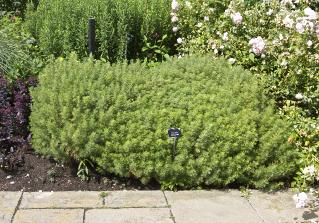
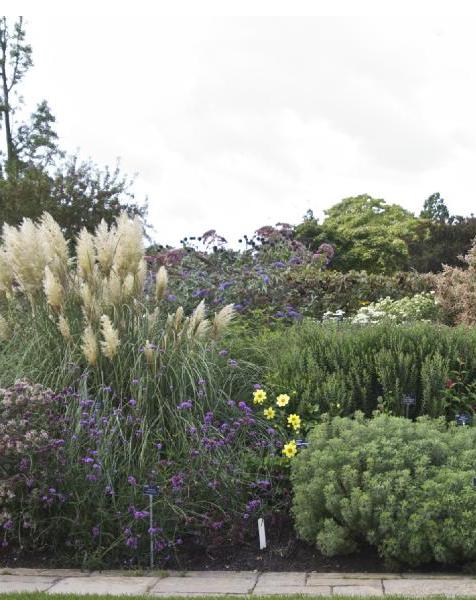
Artemesia See further details in East Border Part 14 about lack of record keeping leading to this plant being overgrown - linkstakes in front of the Pennisetum would have provided a temporary solution from May 2013 onwards. |
Yellow Although these plants were in front of the bed next to the path and in front of Pennisetum orientale 'Shogun'; the Pennisetum overgrew them. |
|
|
||||||
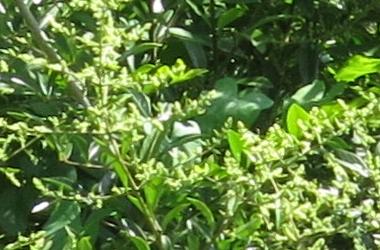
Ligustrum quihoui This image is part of the unreduced original photo taken on 24 July 2013. These plants were at the back of a 240 inch (600 cms) deep bed and the flowers were too small. |
Without the 50 x optical zoom on my current camera, I was unable to take close-up photos of the flowers which were on these shrubs on 24 July 2013. These shrubs are too far back to enjoy their flowers with the naked eye. |
|
|||||||
|
108 x 108 |
During the growing season all new flushes of growth are brilliant red, turning to bronze by late spring then to Dark Green |
|
|
|||||
Evergreen Tree |
|||||||||
|
|
|
|
|
|
|
|
||
Fern |
|||||||||
|
|
|
|
|
|
|
|
||
Grass |
|||||||||
September |
Very rarely flowers in Britain |
240 x 160 |
Grey-Green |
|
See other Grass-Base - The Online World Grass Flora from Royal Botanic Gardens, Kew, England. |
||||
Silvery-grey with Pinkish-Purple tints becomes Golden-Brown |
|
60 x 36 |
Grey-Green |
|
|||||
|
120 x 60 |
Deep Green with razor sharp edges and midrib |
|
||||||
|
60 x 48 |
Dark Green with razor sharp edges and midrib |
|
||||||
|
60 x 40 |
Dark Green |
|
||||||
|
52 x 48 |
Dark Green with White stripe down the leaf centre |
|
||||||
Pink ripens to Silver. |
August, September, October, November, December |
|
100 x 60 |
Dark Green |
|
||||
Rosy-Pink |
July, August, September, October |
Note that the Pink Spikelets were visible on the panorama of West Border Part 68 of 19 Sep-tember but its label was hidden by the plants in front |
100 x 40 |
Dark Green with White Midribs |
|
||||
Grey/ Silver and Pale Pink |
September, October, November |
|
40 x 36 |
Dark Green with White midribs and edges |
|
||||
Pink turning to pure White Unable to locate plant label to take photos of its foliage or flowers after 15 May 2013 |
August, September |
|
56 x 40 |
Dark green |
|
||||
|
Missed taking photos of its Pink Inflore-scences |
August, September |
|
48 x 18 |
Horizontal Cream bands on Dark Green arching foliage |
|
||||
Pale Pink |
|
48 x 32 |
Flat, linear, Blue-Green leaves, turning Yellow-Brown in autumn |
|
|||||
Pale Green ages to light buff |
|
30 x 18 |
Dark Green |
|
|||||
Purple ripens to Gold |
|
100 x 48 |
Slender Grey-Green |
|
|||||
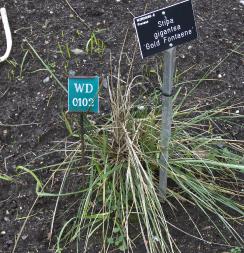
Stipa gigantea Plant removed after 20 January 2013 |
Straw Yellow |
Photo taken on 20 January 2013 in West Border Part 63 |
|
||||||
Hedge |
|||||||||
Carpinus betulus (Hornbeam) |
Green as background hedge to all 71 Parts of Mixed Borders |
May |
|
480 x 320 |
Mid-Green with Brown Autumn and Winter dead foliage |
|
|
||
Herb |
|||||||||
|
|
|
|
|
|
|
|
||
Odds and Sods |
|||||||||
Biennial - Onopordum acanthium |
In the late 19th century, it was introduced to temperate regions of North America, South America, and Australia as an ornamental plant, and is now considered a major agricultural and wildland noxious weed. I would not recommend growing it in your garden, orchard or fields. |
||||||||
Sub-Shrub - Having such a small area of plant, I was unable to find its flowers from 29 August to 30 December 2013. |
September, October Photo taken by H. Kavanagh on 21 August 2013 with the Artemesia being the wide area of green foliage next to the path. |
|
|||||||
Rhododendron/ Azalea/ Camellia |
|||||||||
|
|
|
|
|
|
|
|
||
Rose |
|||||||||
|
Retail name in UK should be |
|
36 x 44 |
Glossy, Mid-Green |
|
See WISLEY WISLEY Rose Classification System Page for details on this Rosa Retail Name 'Trade Name' RHS naming system. |
||||
Rosa glauca 'Carmenetta' and Page in RHS Wisley Bowes-Lyon Rose Garden Roses |
|
78 x 78 |
Green with Grey reverse |
|
|||||
Soft Fruit |
|||||||||
|
|
|
|
|
|
|
|
||
Top Fruit |
|||||||||
|
|
|
|
|
|
|
|
||
Vegetable |
|||||||||
|
|
|
|
|
|
|
|
||
Wildflower |
|||||||||
|
|
|
|
|
|
|
|
||
|
|||||||||
|
Site design and content copyright ©January 2014. Added Camera Photos of Plant Supports Gallery Link June 2019. Chris Garnons-Williams. DISCLAIMER: Links to external sites are provided as a courtesy to visitors. Ivydene Horticultural Services are not responsible for the content and/or quality of external web sites linked from this site. I am attempting the same free link to mail-order nurseries for the people of Europe, Latvia, America, Canada, Australia, New Zealand and China.
|
||||||||
|
|||||||||

















 Pincushions - The pincushions of plants such as scabious (Scabiosa columbaria from

Copied from Ivydene Gardens Mixed Border Other Permanent Plants Gallery: |
The Other Permanent Plants from the Mixed Borders in the Garden at RHS Wisley in this Gallery are neither their Bedding plants nor their Permanent Herbaceous Perennials. All the Permanent Plants in a bed are their to provide a structure where all of its plants when they are in flower can be seen and identified when in a garden that is displayed to the public. |
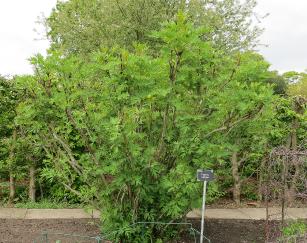
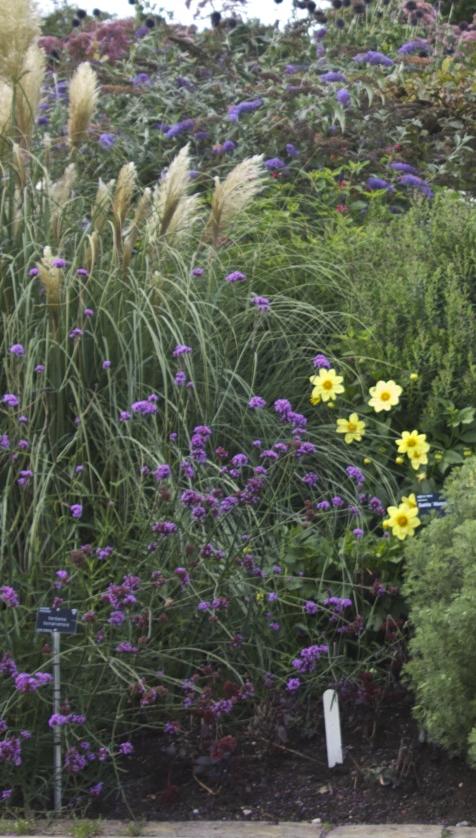
This Buddleja davidii nanhoensis 'Nanho Purple' plant is in the West Border Section 7 Part 57 and you can see it in flower in the photo below taken 19 September 2013.
It has the purple flowers at the back of the border in the middle of this panaroma shot of that section. We will now expand this photo to find its plant label.
Unfortunately we cannot see its label.
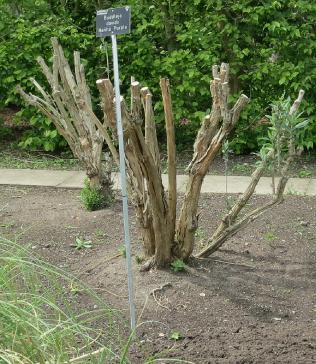
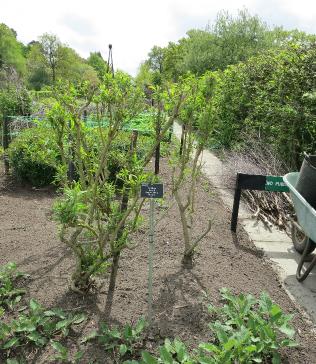
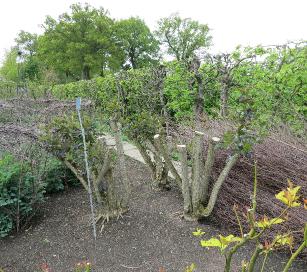
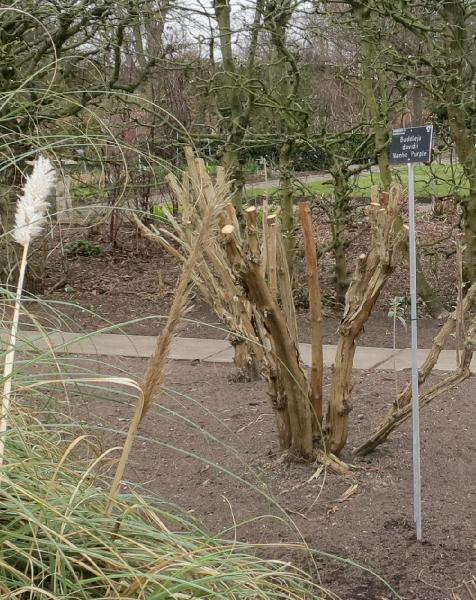
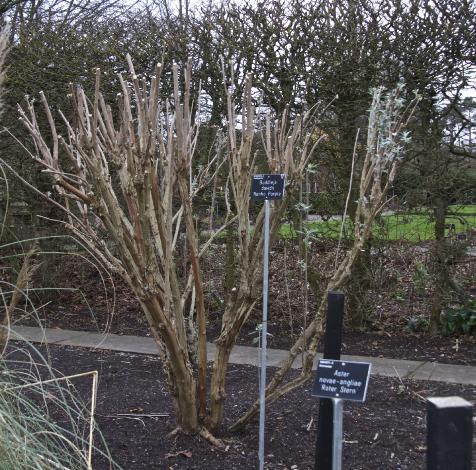
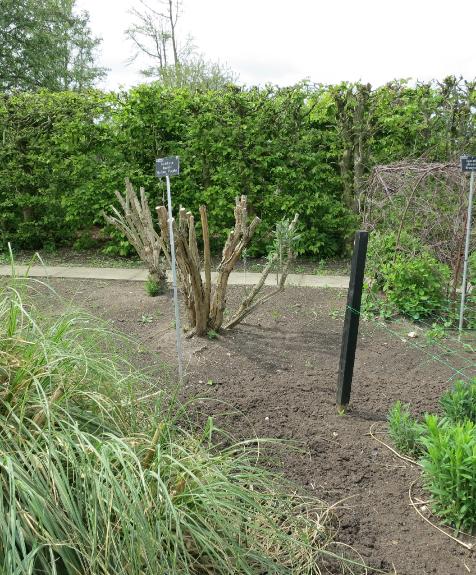
The above photo was taken on 4 March 2013 and shows that the Miscanthus in front of it is still higher than the Black Plant label for this Buddleja. If that plant label was not elevated that could be the reason why no plant label for that buddleja was seen in September 2013. What is the point of having plants in a display garden, that visitors cannot identify when they are in flower. This buddleja had its crown reduced in height by the staff at RHS as shown by the following photo taken on 20 January 2013
and the following shows the right hand side:-
If one leaves this amount of young branches in such a confined area then summer growth will become a congested mess.
The Pruning of trees, Shrubs and Conifers by George E. Brown published in 1977 in Faber Paperbacks - formerly Assistant Curator in Royal Botanic Gardens at Kew - was recommended as one of the books from Hadlow College where I took a course for a year from 1990-1991 to learn about horticulture. The following is what it states about pruning Buddleja daviddii :- "Those which flower terminally on the current season's wood. With these, the habit of growth and flowering is such that the late spring and early summer are devoted to the formation of shoots which are often 100 or 200 cms (40-80 inches) in length. These are eventually terminated by the inflorescence, which opens and sets seed all in the same season, as that in which the growth is made. Buddleja davidii Franch. and the various cultivars of this species all have this habit. Left unpruned, they develop into large spreading bushes full of dead wood and small branches which blossom poorly. Hard pruned annually in the spring, taking each shoot back to the lowest growths, the vigour is channelled into fewer shoots which as a result are strong with corresponding panicles of blossom. The pruning may either be carried down to ground level or to a main framework of a few branches about 90 -120 cms (36-48 inches) in height according to vigour. The need for a larger framework is indicated when the growths are excessively vigorous, especially at the top of the bush, and in order to achieve it, selected, well-positioned growths should only be pruned to half their length for the first 2 or 3 years after planting. All buddlejas are sun lovers. The soil should be well-drained but they are strong growers and require feeding and mulching. This is especially true of those which are pruned hard each year. They all respond well by growing from really old wood if the shrub is cut back hard."
In the start of winter, when the current season's growth has finished and the new growth has just started; then I would prune buddlejas down to a maximum of 24 inches (60 cms) high and reduce each branch to an outward facing new shoot. I would also remove a third of the oldest trunks to ground level, so that I would end up with 1 year, 2 year and 3 year old trunks. I then had buddlejas with their flowering height at about the height of client's eyes each year. |
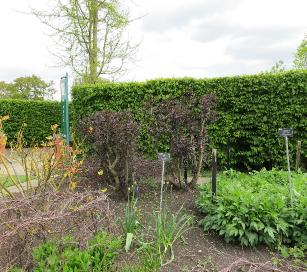
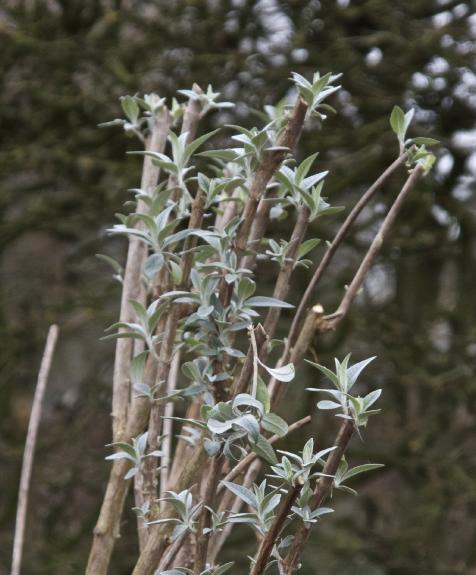
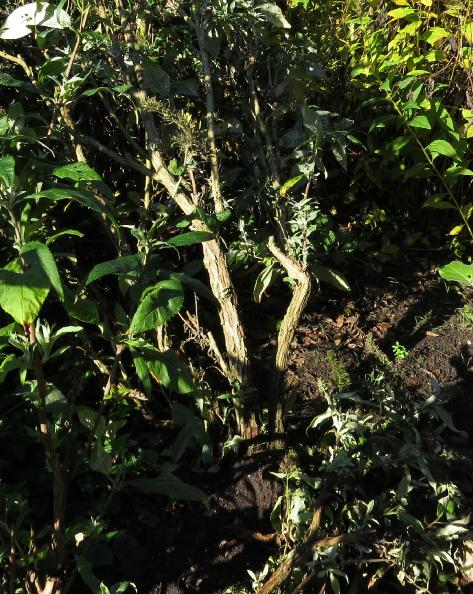
The following shows the foliage of the Buddleja davidii nanhoensis 'Nanho Purple'on 15 May 2015:-
but no further photos where this buddleja could be identified were taken after 15 May 2013. It does not seem to have been mulched to provide its nutrients and all its trunks are very mature; perhaps over 10-15 years old. |
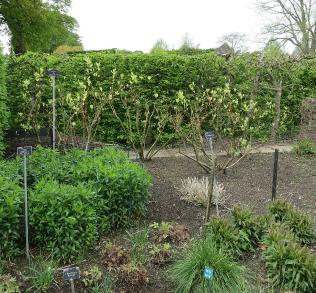
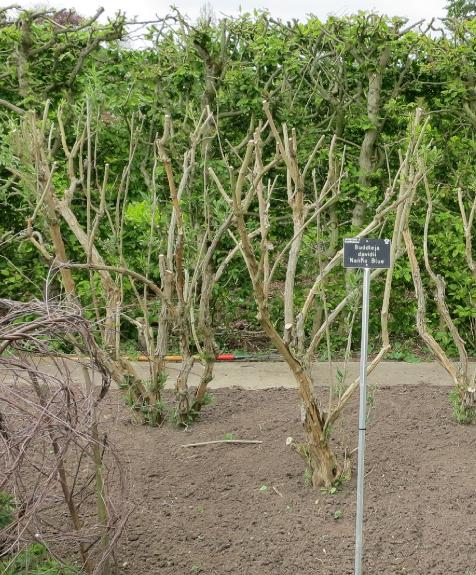
The same pruning problems have occurred with the Buddleja daviidii nanhoensis 'Nanho Blue' (Photo taken on 15 May 2013)
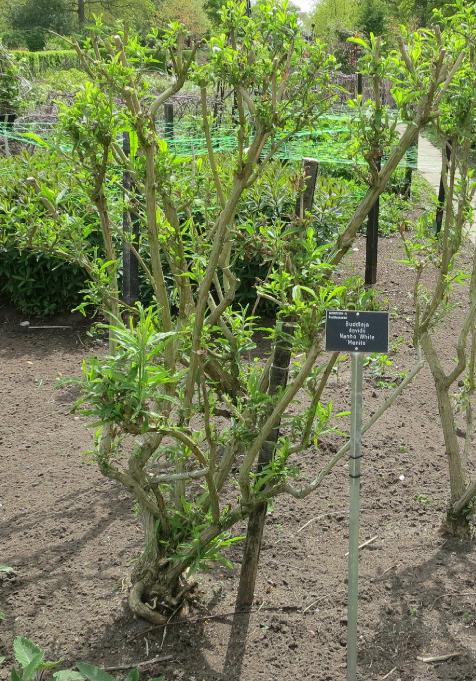
and the Buddleja daviidii nanhoensis 'Nanho White' (Photo taken on 15 May 2013) in these Mixed Borders
These Buddleja davidii 'Peacock' were blown out of the ground by the storm before 10 November 2013:-
and then replanted as shown in the Lost Flowers Page. Since half its roots had been broken for it to be blown over and because of its age, this buddleja should have been replaced. I do realise that because the Royal Horticultural Society is suffering financially in these austere times (over £19,000,000 excess income over expenditure in 2012-2013) and lack of visitors to this garden (1,000,000 in 2012-2013), that donations should be sent to the RHS Garden, Wisley Lane, Wisley, Woking GU23 6QB:-
Including the banana and/or the Dog biscuits might get the RHS to take note.
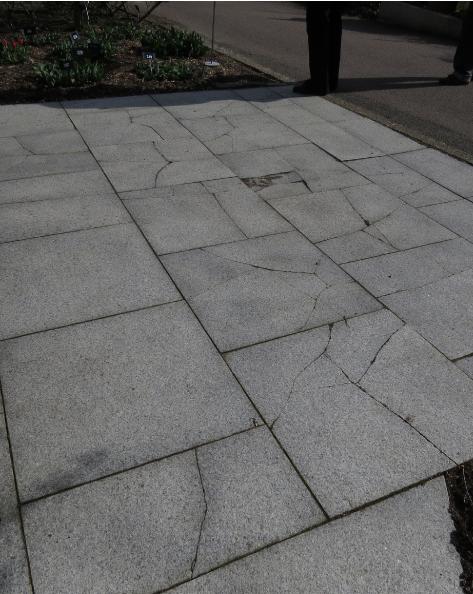
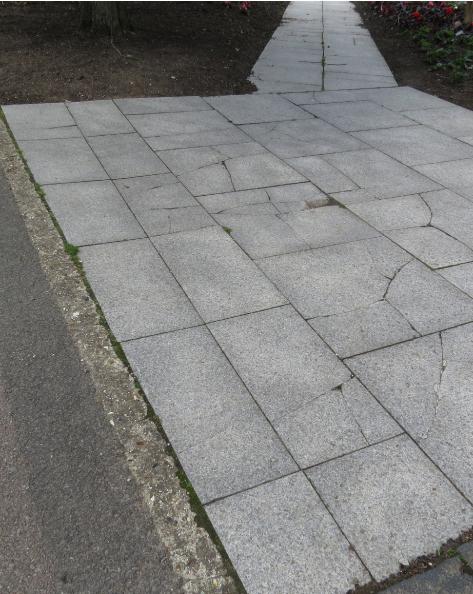
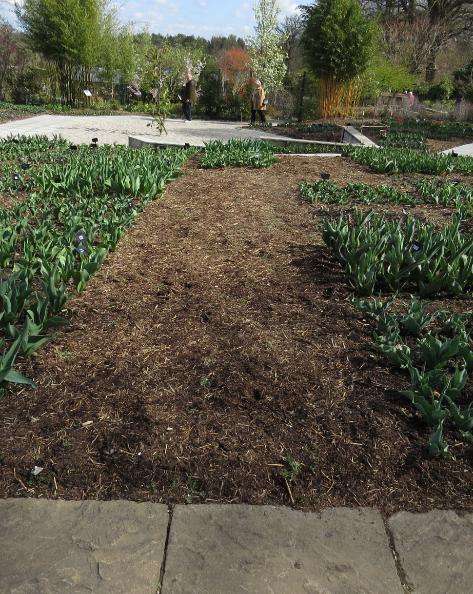
Photo taken on 24 March 2014 of existing path alongside current Tulip Trial.
Above Photo of same path section taken on 15 June 2013. Safety issue?
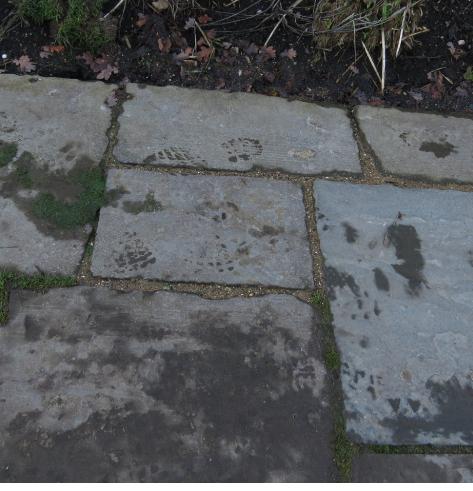
Pavement repaired with sharp sand. Photo taken 10 November 2013.
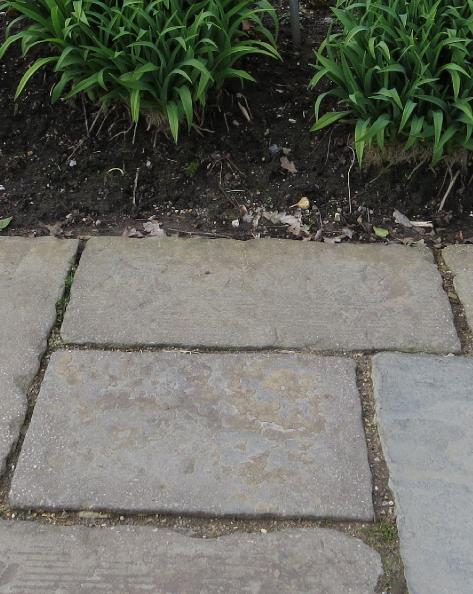
Photo taken 24 March 2014. The sand used between the slabs and their neighbours appears to have become soil.
Photo taken on 24 March 2014 looking at temporary visitor viewing path to see part of Tulip Trial. I wonder what would happen when a wheelchair being pushed by its carer uses this - after it has rained. |
|
Copied from Ivydene Gardens Mixed Borders in RHS Garden at Wisley Garden Design: |
||||||||||||||||||||||||||||||||||||||||||||||||||||||||||||||||||||||||||||||||||||||||||||||||||||||||||||||||||||||||||||||||||||||||||||||||||||||||||||||||||||||||||||||||||||||||||||||||||||||||||||||||||||||||||||||||||||||||||||||||||||||||||||||||||||||||||||||||||||||||||||||||||||||||||||||||||||||||||||||||||||||||||||||||||||||||||||||||||||||||||||||||||||||||||||||||||||||||||||||||||||||||||
This section details what I consider as errors in design carried out by the staff at the RHS garden in Wisley:-
Mixing all the primary colours together for the flower colours used in many of the 71 parts of these Mixed Borders This mixture provides a foliage and flower foil against which these other permanent herbaceous perennials can provide new growth from the ground each year, with the different colours of foliage from juvenile to mature to dying off in the autumn and then an easy maintenance during the months of December-March for removing most of the growth above ground and replacing the plant supports to provide a neat bed in a series of large ground areas. The bedding plants - see Bedding Annual Plant Index and Un-labelled Bedding Annual Plant Index pages - provide the icing on the cake at different flowering time periods between May and November to enhance the overall flower colour scheme. The new bedding each year can provide opportunities to vary the look of these beds. It was disapointing that I did not see the flowers during 2013 of more than 25% of these Permanent Herbaceous Perennial Plants - possible reasons shown in Lost Flowers Page with 'Walkabout' Plants and 'Stateless' Plants Page. A table for each month - May, June, July, August, September, October, November - shows the flower photos for each of the 71 parts of the Mixed Borders split into Blue, Orange, Pink, Red, Unusual Colour, White, or Yellow for all the plants. Besides that, you can see from the table below that Red and Pink with Unusual Flower Colours seem to be predominant as flower colours and that these are spread throughout the beds.
I have added the BEDding (started January 2014 - completed March 2014) and then the OTHer Permanent Plants (started March 2014 - completed May 2014) to the table below to show the flower colour planting scheme of the Bedding and the Other Permanent Plants and then its combination.
If I had produced this planting design with its mixture of flower colours in almost every part - or maintained these beds in this way - in 2013, I would be deeply ashamed. As a nation of gardeners in Britain; the Royal Horticultural Society being at its pinnacle, with the tradition of excellence by our previous head gardeners and their staff during the Victorian era, I had thought that the staff at the RHS Garden at Wisley would not need a lecture.
Another Possible Solution for lack of coordinated Flower Colour Scheme If you want the garden to be restful to the eye, then you can provide a colour scheme using the harmony of adjacent colours. If you prefer to shock the visitor, then use the contrast of opposite colours, but I am not favourable of the above partial use of the harmony of triads as shown by the Colour Wheel Page of Garden Design.
Very Poor Plant Labelling After reviewing the situation that 102 plants were missing their identity when in flower in 2013 out of 348 (29.31% of the plants) in 768 square metres of Mixed Borders garden beds:-
|
||||||||||||||||||||||||||||||||||||||||||||||||||||||||||||||||||||||||||||||||||||||||||||||||||||||||||||||||||||||||||||||||||||||||||||||||||||||||||||||||||||||||||||||||||||||||||||||||||||||||||||||||||||||||||||||||||||||||||||||||||||||||||||||||||||||||||||||||||||||||||||||||||||||||||||||||||||||||||||||||||||||||||||||||||||||||||||||||||||||||||||||||||||||||||||||||||||||||||||||||||||||||||